


Mati now at the Talión
- Mati
- Dec 28, 2025
- 10 min read

There are two ways to look at the world.
One is from space: where you stand, what angle your feet form, how you anchor your body to the earth. That is the gaze of the heel. The gaze of yomati.red.
The other is from time: how you move, what rhythm you follow, what steps you take and when you take them. That is the gaze of talion. The gaze of soymati.red.
Heel and talion. Position and law. Space and time.
Two eyes that look at each other. Two eyes that calibrate each other. One eye guides the other. Mati guides mati.
THE LAW OF TALION
We have all heard the phrase: "An eye for an eye, a tooth for a tooth."
And when we hear it, we think of revenge. Of violence. Of a brutal code of primitive justice where if you take my eye, I take yours.
But that is not its truth.
The law of talion —lex talionis in Latin— was not born as a war cry. It was born as a principle of balance. As a way of saying: when something breaks, it must be repaired with equivalence. Neither more nor less. Neither excessive revenge nor empty forgiveness. Only balance.
Equilibrium.
The word talion comes from the Latin talis, which means "such as" or "similar to." It is the root of comparison. It is the principle that says: what you give, you receive. What you break, you repair. What you sow, you harvest.
It is not punishment. It is calibration.
And in the middle of that calibration, there are two eyes observing each other.
MATI GIA MATI: EYE FOR EYE
In Greek, "eye" is mati (μάτι). And the phrase "eye for eye" is mati gia mati (μάτι για μάτι).
But listen to this carefully: eye for eye does not mean eye against eye. It means eye toward eye. Eye to eye. One eye looking at the other. One eye calibrating the other.
Mati gia mati.
One eye guides the other.
When your two eyes are not aligned, you see double. You see blurry. You cannot measure distance. You cannot walk without stumbling. But when both eyes focus on the same point, when they calibrate each other, something appears that did not exist before: depth.
The ability to see in three dimensions. The ability to navigate space.
That is mati gia mati. It is not revenge. It is complete observation. It is the adjustment between two perspectives until the image becomes clear.
And the same happens between yomati.red and soymati.red. Between the eye of space and the eye of time. Between where you are and where you are moving.
One eye guides the other. And when both align, you can see the complete path.
ERROR AS MISALIGNMENT
When I was a child, I was taught that "to sin" meant to do something wrong. But years later, I discovered that the Latin word peccatum means "to miss the mark," "to lose the step," "to go off the path."
It is not a moral judgment. It is a geometrical misalignment.
Imagine you are walking on a narrow mountain path. If your foot is placed a few centimeters outside the correct angle, you lose your balance. Not because you are bad, but because the geometry of the terrain demands a specific position. If you deviate, you fall.
That is how the laws of the cosmos work. They are not divine punishments. They are natural laws of equilibrium. When your spine is twisted, when your feet do not form a right angle, when your coccyx is not correctly anchored, your entire system becomes misaligned. And the universe, which always seeks to return to center, begins to push you back.
That is why in all ancient traditions there are phrases that seem poetic but are precise instructions:
"Be flexible like the reed."
"Bloom like the lotus that rises from the mud."
"Stand firm like the mountain."
These are not pretty metaphors. They are geometries of behavior. They are telling you: behave such as the reed, bloom such as the lotus, anchor your root such as the mountain.
Such as.
In Latin, that phrase is talis. And from there comes the word talion.
Talion is not revenge. It is imitation. It is learning to behave such as the correct pattern. It is adjusting your internal geometry until it coincides with the geometry of the cosmos.
THE POWER OF ANIMALS
The first humans did not have books of laws. They had animals.
They observed the bear and learned strength.
They observed the eagle and learned vision.
They observed the serpent and learned transformation.
Power did not come from inventing new things. It came from imitating what already existed. From behaving such as the animal. From aligning with its geometry, its rhythm, its essence.
That is animism. And that is the first talion: learning to be like something greater than you, until that force becomes part of you.
And in the sky, all those animals united into one: the dragon.
The dragon has scales of fish, wings of eagle, claws of lion, body of serpent. It is the synthesis of all animal powers. It is the kundalini rising through the spine, touching each chakra, each zodiacal sign, until reaching the crown and becoming pure vision.
But the dragon does not attack. The dragon guards.
In Greek, drakon (δράκων) comes from derkein (δέρκειν), which means "to see clearly," "to observe." The dragon is the guardian. The one who observes without blinking. The one who holds the center.
In Greek mythology, the dragon Ladon guarded the golden apples in the Garden of the Hesperides. In the sky, the constellation of Draco surrounds the north celestial pole, with Alpha Draconis marking the fixed point around which all stars revolve.
The dragon does not judge. The dragon calibrates.
And the Sphinx does the same. Seated at the entrance of Thebes, it does not attack those who pass. It simply asks. And if your answer is outside the talion—if your mind is misaligned with truth—it reflects your own error back to you.
The Sphinx is a mirror. And the dragon is an observer.
Both are there to help you calibrate.
THE FIRST LAWS
It was in Mesopotamia where this became official.
The Code of Hammurabi, written almost 4,000 years ago, is one of the first written records of the law of talion: eye for eye, tooth for tooth.
But it was not revenge. It was equilibrium. It was the idea that if you break the geometry of social order, society must restore that geometry. Not with more violence, but with equivalence. With balance.
Talion does not seek to destroy. It seeks to calibrate.
And long before Hammurabi, another law existed. A law that was not written in stone, but in the very structure of the cosmos.
The Seven Universal Laws of the Kybalion, attributed to Hermes Trismegistus —Hermes with his talaria, the winged sandals on his heels— are the first universal talion.
Hermes, the messenger between worlds, the one who flies with wings on his heels, created the first code that did not need judges or armies. It only needed observation.
These seven laws describe how everything works:
Mentalism: All is mind. The universe is mental.
Correspondence: As above, so below. As within, so without.
Vibration: Nothing rests. Everything vibrates.
Polarity: Everything has two poles. Opposites are identical in nature, different in degree.
Rhythm: Everything flows and ebbs. Everything has its tides.
Cause and Effect: Every cause has its effect. Every effect has its cause.
Generation: Everything has its masculine and feminine principle. Generation manifests on all planes.
These laws are not commandments. They are descriptions of how the cosmos calibrates itself. They are the instruction manual of the dragon. They are the way one eye guides the other.
And Hermes, with his winged heels, was the first to walk between worlds carrying this message: chemistry and alchemy, science and spirit, heel and talion, are two faces of the same truth.
The elements of the world are ordered through the laws of consciousness.
Heel and heal. Heel and talion.
One eye guides the other. Mati guides mati.
HERMES SPOKE TO ME
It was in 2012, in the Canary Islands, when Hermes spoke to me for the first time with clarity, without even knowing it was him.
It was not an external voice. It was an understanding that arrived complete, as if it had always been there waiting for me to stop long enough to listen.
He told me: "You must move through the world to position yourself in different places. That is your heel. And in each place, you must seek the myths and ideas that are outside the talion, and correct them to the original talion with the correct position of your heel."
I did not fully understand at that moment. But years later, he said something more:
"Mati gia mati."
Eye for eye.
Not as revenge but as calibration. As balance between two observations. As the adjustment between wave and particle, between space and time, between where you are and how you move.
That was the origin of YOSOY.
One eye looking at the other. One eye guiding the other until both see the same truth.
And then he added: "Boat for boat."
When you correct the observation, you can navigate the ocean of consciousness. When your two eyes are aligned, you can see the depth of the sea and move through it without getting lost. One boat guides another boat. One route calibrates the next.
And upon arriving at port, he said: "Oak for oak."
The oak here represented the two trees of the Garden of Eden, of life and of knowledge. The oak is the tree under which pacts and laws were kept in ancient traditions. In Gernika, in the Basque Country, the oak is the symbol of the assembly, the place where decisions were made that guided the people.
Oak for oak. Life for life. Law for law. One tree holds the other.
But something was missing. A fourth phrase. And I did not hear it until December 2025.
TOOTH FOR TOOTH: THE THRONE OF HERMES
In December, before the solstice, I traveled with a group of 36 people to Laguna Esmeralda in Ushuaia, Tierra del Fuego.
We walked for hours through the mountain. It was cold. Then the sun came out. Then it snowed. Then came the wind. Then calm. A little of everything, as if the sky wanted to show us all its states in a single day.
And when we arrived at the lagoon, something changed.
The water was an impossible emerald green, as if someone had poured liquid light into the earth. And behind the lagoon, there was an enormous rock formation that locals call Muela de Lorena (Lorena's Molar).
But it is not just any molar.
It is Hermes' throne.
Hermes told me right there, as I looked at that rock: "This lagoon is at the boundary between the Scotia plate and the South American plate. Here the world settles. This is the coccyx of the earth. The heel of Argentina. And that throne is mine."
The Emerald City. At the foot of the world. The place where Dorothy clicks her heels and returns home.
And then Hermes asked me something that pierced through me like a nail:
"Do you want to be an alchemist or a tour guide?"
Almost mockingly. Almost threateningly.
Because I was there, guiding 36 people, concerned that everyone was okay, that no one got lost, that the experience was beautiful for them. And Hermes told me:
"You are not where you belong. You are not positioned correctly. You are guiding others instead of sitting on your own throne."
It made me feel a horrible vertigo. Because he was right.
So, without saying anything to anyone, I ran toward that rock. I sat where I should sit. And by resonance—because that's how it works when you align correctly—everyone arrived on their own. Everyone held, magically, what happened there.
And then Hermes said the fourth phrase:
"Tooth for tooth."
He told me: "Someone has usurped Hermes' throne, destroying the mind in the labyrinth of the ocean of consciousness. And as long as you do not sit to understand this, as long as you do not position yourself correctly in this alchemical game of the mind with firmness, you will be just like him."
Tooth for tooth.
The next day, a molar fell out.
THE MOLAR OF RESPONSIBILITY
It was not a cavity. It was not a blow. It simply loosened and came out.
The lower right molar, the one just before the wisdom tooth. In biodecoding, that molar represents ancestral responsibility. The weight of where you come from. The burden of what you inherited.
I had to keep it in my pocket during the entire return trip. And the first thing I did upon arriving in Tenerife was go to the dentist.
"Tooth for tooth," Hermes had said.
And I understood: this is a wake-up call. A reminder to respect cosmic law. That if I want to do an alchemist's process, I cannot be concerned with the observation of others' eyes, but with my own eyes.
Eye for eye. Tooth for tooth.
One eye must guide the other. And my eye must guide my own eye. Mati guides mati. Not the eyes of others guiding mine.
THE PATH OF THE NEXT THREE YEARS
The next three years of the alchemical path will be a path of temporal calibration.
It is not about doing more things. It is about doing things in the correct rhythm. About learning to read time as the dragon reads the sky: without blinking, without judging, only observing until the pattern becomes clear.
The dragon does not attack. The dragon guards. The dragon calibrates.
And that calibration is not violent. It is subtle. It is like tuning a musical instrument until the note sounds perfect. It is like turning the dial of a radio until the static disappears and the signal is clear.
That is the true talion. Not revenge, but adjustment. Not punishment, but return to center.
And this requires something we have forgotten: respecting cycles. Respecting each person's timing. Respecting that each person, each process, each transformation has its own rhythm, its own law, its own talion.
You cannot force a lotus to bloom faster. You cannot force a reed to be rigid. You cannot make a mountain move.
You can only observe. Calibrate. Adjust your own step to the real rhythm of things.
THE QUESTION
And now I ask you, who are reading this:
Do you respect your own time?
Or are you living to the rhythm of others, moving your feet to the beat of music that is not yours?
Do you respect your own law?
Or are you following external rules that were not born from your spine, from your angle, from your internal geometry?
Are your two eyes aligned?
Or are you seeing with one eye toward space and another toward time, creating a blurry, fragmented vision without depth?
Does your eye guide your eye, or do you let the eyes of others guide your gaze?
Because this path that begins—this path of three years of calibration—is not for everyone.
It is only for those willing to sit on their own throne. To find their own heel. To walk at their own rhythm. To observe with their own eyes.
Mati gia mati.
Eye for eye.
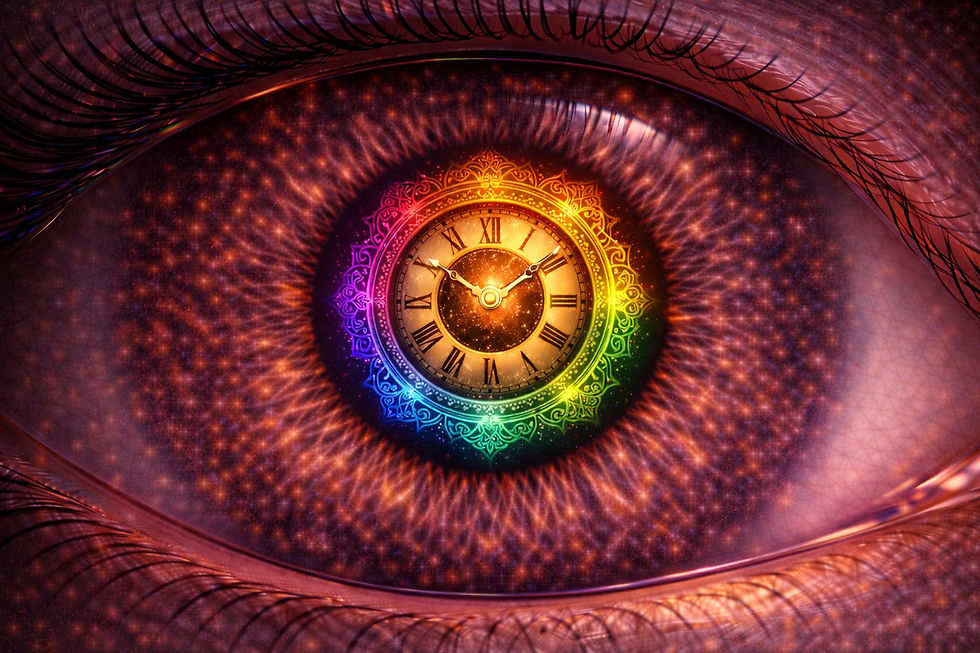


I am learning so much! This graphic helped me grasp this message and integrate it into my understanding.
And to everybody here !
Thank you Mati 💜🫶
This hits home strongly for me as well, as I am in the midst of powerful transformation. This coming year (on all calendars) is one where my life before me is a blank slate, as I feel more and more called to follow my inner calling, even if consciously I got no idea what it is truly… these questions at the end truly are matter of reflections for me in order to align with what I feel is needed of me. Thank you!
I see the problem, one eye is 5rying to consume the other eye instead of resonating and aligning to generate the correct vision, it is seeking to become the other, afraid to be two.