


Mati now in Momentum
- Mati
- Jan 9
- 5 min read

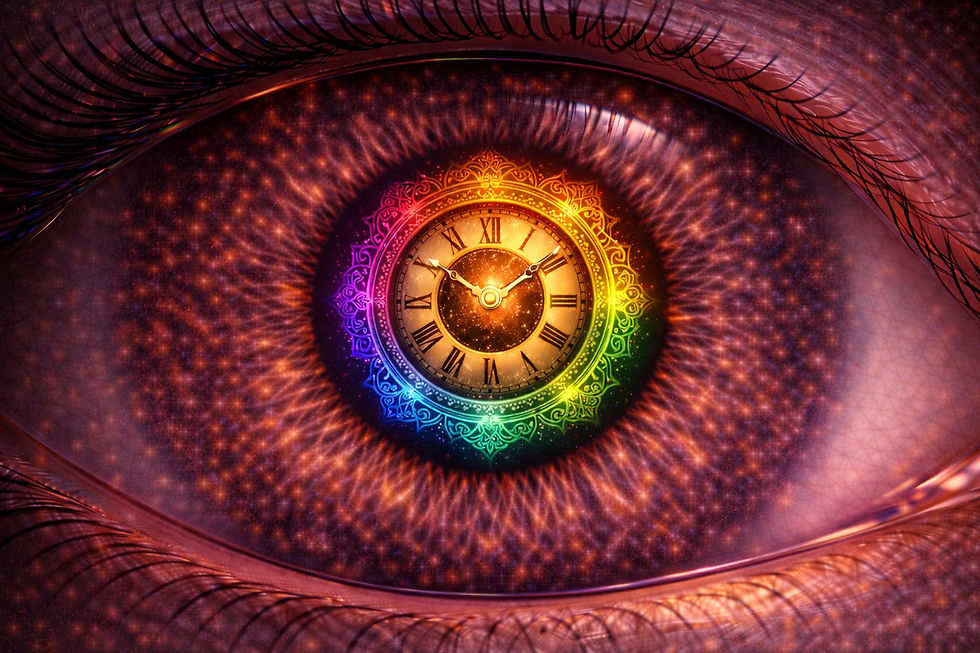
For a long time, I tried to understand time the way I had been taught. As a line that begins at one point, moves forward, and ends at another. A before, a during, and an after. A past that is already gone, a future that has not yet arrived, and a present that slips through the fingers.
But the more I observed reality—and the more I observed myself within it—the more evident it became that time does not work that way.
Time does not move in a straight line. Time folds.
It expands, contracts, overlaps with itself. Sometimes it advances, sometimes it retreats, sometimes it seems to stop completely. And in that movement, which is not mechanical but alive, there are moments where everything concentrates. Instants in which all of history seems to gather into a single point, as if past, present, and future ceased to be separate and touched one another.
Those instants do not last long. But they change everything.
In alchemy, this kind of moment is called Momentum.
Momentum is not a quantity of time. It is not a date. It is not an isolated event.
It is a point of maximum intensity, where the fabric of time becomes so dense that it can be recalibrated from within. An instant where history is not only observed, but where history can return to its origin and reorganize itself.
The Opus Magnum: the Great Work beyond gold
Alchemy has always spoken of the Great Work, the Opus Magnum. For centuries it was interpreted as the attempt to turn lead into gold, as if alchemists were naïve chemists chasing material wealth.
But that reading was always superficial.
The gold spoken of in alchemy is not a metal. It is a state of coherence.
The Opus Magnum is the process through which something fragmented returns to order, something sick returns to health, something separated becomes integrated again. The famous Philosopher’s Stone is not a stone, but a state of matter—and of consciousness—where everything that comes into contact with it reorganizes, elevates itself, and becomes medicine.
In that sense, traditional alchemy worked primarily with space: with matter, bodies, elements, with the transmutation of what is dense into something more subtle.
But there is another alchemy, less named and even deeper still: the alchemy of time.
If the Philosopher’s Stone transmutes matter, Momentum transmutes history.
It does not turn lead into gold. It turns the past back into origin.
And here something essential appears: the Great Work is not only the Philosopher’s Stone, nor only Momentum. The Great Work occurs when both alchemies meet— when space is transmuted and time is recalibrated at the same time.
That is the complete Opus Magnum.
The four great states of transformation
The Great Work does not happen all at once. There are no shortcuts.
Alchemy is a long process because real transformation needs time—and it also needs to pass through layers. That is why alchemists described four great states, represented by colors, which are not poetic symbols but real stages of human and material experience.
Nigredo – blackening
Nigredo is the beginning. And it is uncomfortable.
It is the stage where everything we believed to be solid begins to fall apart. Where certainties collapse, identities crack, and the narratives that sustained us stop working. It is the dark night, confusion, the feeling of being lost.
Nigredo is death. But not an external death—rather, the death of the ego as a rigid structure. It is the moment when the old begins to rot so that it can transform. There is no light yet, but there is truth. And that truth usually hurts.
Albedo – whitening
After darkness, water appears. Albedo is the process of purification.
The ashes of Nigredo are washed. Emotions surface. A first clarity appears—not as absolute certainty, but as the capacity to see oneself with greater honesty. The Moon illuminates what was previously hidden.
In Albedo, the soul begins to detach from identifications and to observe itself from another place. There is no integration yet, but there is awareness.
Citrinitas – dawn
Citrinitas is the dawn of the process. The Sun begins to rise.
Here wisdom ceases to be only mental understanding and begins to incarnate. Opposites no longer reject each other; they begin to dialogue. Masculine and feminine, inner and outer, heaven and earth start to recognize one another.
The gold is not yet complete, but it is already being formed.
Rubedo – reddening
Rubedo is consummation. The red of living fire, of the Sun at its fullness.
Here separation disappears. Matter and spirit cease to be opposites. Experience becomes fully integrated, and the Philosopher’s Stone activates as a permanent state, not as a single event.
The seven alchemical processes and the architecture of time
Within these four states, alchemy describes seven fundamental processes. They are not steps that are completed and left behind; they are movements that repeat, deepen, and refine themselves.
Calcination, dissolution, separation… each fulfills a specific function in transformation.
But there is one that organizes all the others.
The fourth process, called Coniunctio.
Conjunction is the union of opposites. Sun and Moon. Space and time. “I” and “I Am.”
And this is key: Coniunctio is not the end of the path. It is the center.
The first three processes occur before it. The last three occur after it.
If the process does not continue after conjunction, there is no real transmutation.
The eclipse as Coniunctio: Luxor and the center of time
The total solar eclipse of August 2, 2027 is not the closure of the process. It is its exact midpoint.
Before that eclipse, three eclipses will already have occurred, corresponding to the first three alchemical processes, and along that stretch Nigredo and Albedo will have been traversed. Matter will already have been broken down and purified. The descent and the cleansing will already have taken place.
The eclipse of August 2, 2027 marks the fourth process: Coniunctio.
From that moment on, the path continues. After that eclipse, three more eclipses will follow, allowing Citrinitas and Rubedo to unfold, thus completing the seven alchemical processes.
It is no coincidence that this midpoint occurs in Luxor, the ancient capital of Kemet, one of the great alchemical centers of the ancient world. There, time, sky, and matter were conceived as a single thing. That the longest eclipse of the 21st century occurs in that place, at the moment of the greatest solar and lunar alignment of the century, is not poetic symbolism—it is temporal calibration.
Momentum does not activate because something ends, but because something aligns at the center.
But alchemy is clear: if the process stops in the middle, there is no transmutation.
That is why this path is woven through seven eclipses, crossing the seven alchemical processes—not to reach an end, but to heal the entire history, before and after the midpoint.
The Opus Magnum as alchemy of time
This project does not seek to rush toward a goal. It seeks to reorder time from within.
Traversing the 92 elements is part of that weaving—not as repetition of information, but as a living pedagogy in which body, Earth, and cosmos realign in the correct time.
Because the true gold is not at the end of the path. It is in the sustained center of the process.
And when space and time meet, when the Philosopher’s Stone and Momentum recognize one another, a new state of consciousness is born.
That is the Opus Magnum. That is the alchemy of time. Welcome to the Great Work.


Chef D’oeuvre.
Here we glow…✨⭐️⭐️⭐️😃
Thank you! 🙏🏻
Wow
thank you☺️
I can feel all these words in mind somehow..thank you for the invitation again it is a joining with self and others that makes sense